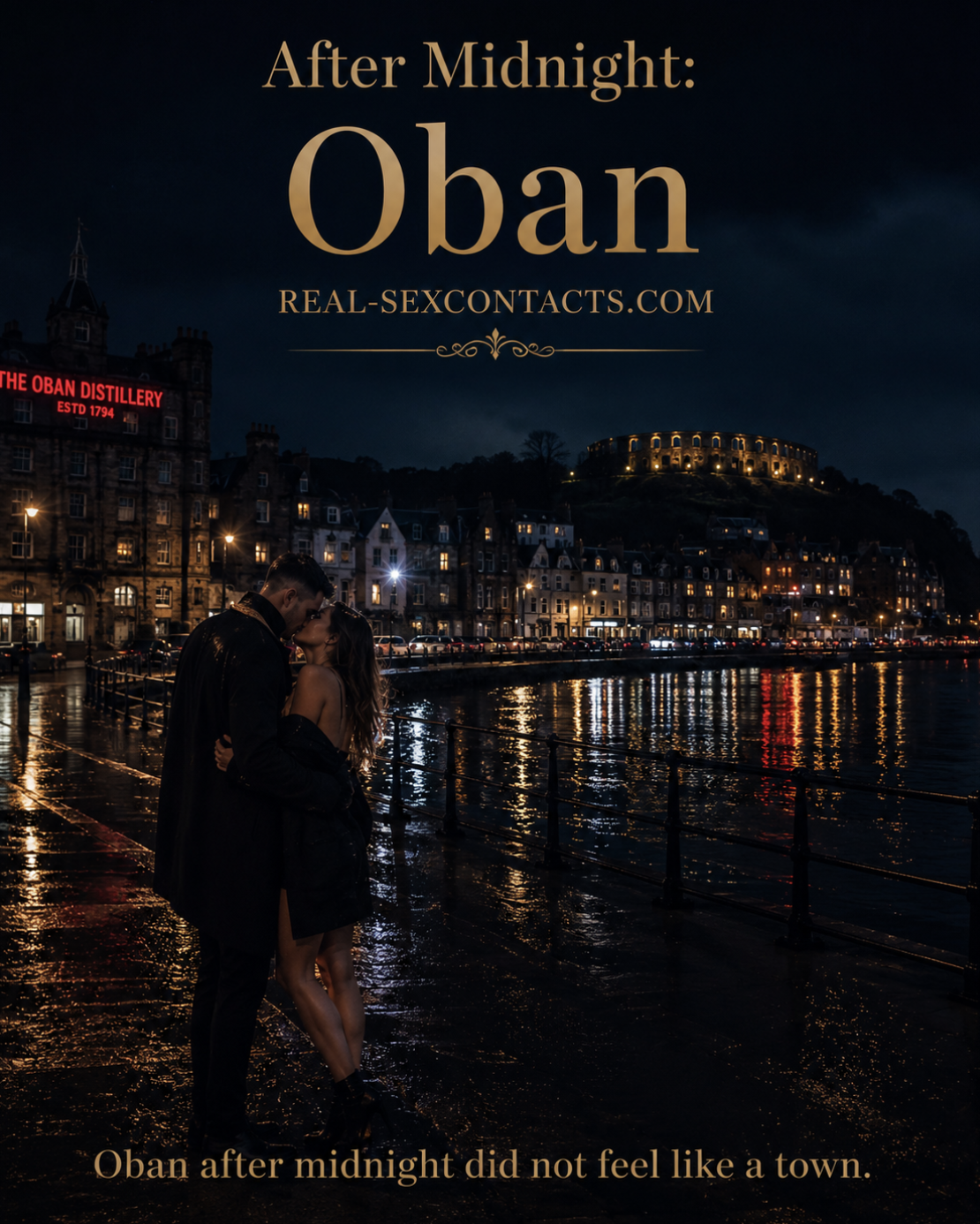
Oban after midnight did not feel like a town.
It felt like the edge of a thought.
The sea was the first thing you noticed, even when you could not fully see it. It was there in the darkness beyond the window, in the salt carried faintly through the air, in the way the lights along the harbour broke and trembled on the water as if the night itself were breathing. Oban was never loud about its beauty. It did not need to be. It let the sea do the talking. It let the silence keep the better part of the story.
From the hotel window, the harbour looked like something half-remembered.
Small lights burned against the dark.
The wet streets below shone faintly beneath the lamps.
A late car moved slowly along the front, then disappeared, leaving the town to its reflections and its hush.
Beyond that was only water and blackness and the faint suggestion of ferries sleeping in the bay like enormous secrets.
Oban at that hour was not merely romantic.
It was hauntingly so.
Inside, the room was warm enough to feel almost indecent against the night outside.
A lamp cast amber light across white linen.
A bottle of champagne rested untouched in silver.
Two glasses waited near the window.
Her heels stood beside the chair, close together, elegant and accusing, as though they knew exactly what kind of night this had become before either of them had admitted it.
She was standing at the glass when he looked up.
One hand lightly against the window.
Dark water behind her.
A reflection so soft and blurred by rain that she seemed less like a woman standing in a hotel room and more like a figure a lonely writer might invent and then regret inventing too well.
“Oban feels dangerous at night,” she said.
He smiled from across the room. “Dangerous?”
She turned slightly, and the light caught her mouth, her shoulder, the unreadable calm in her expression.
“Not the obvious kind,” she said softly. “The kind that looks gentle.”
That made him laugh quietly.
That was the first thing he had liked about her — the way her words never arrived alone. There was always another meaning moving beneath them, darker and more interesting than the first.
The second thing had been her profile.
He found it late on OBAN SEX CONTACTS , at the sort of hour when people either became careless or unexpectedly honest. Hers had not been loud. It had not tried to be seductive in any obvious way. That was what stopped him. It had stillness. Taste. A kind of self-possession that made lazy messages feel embarrassing before they were even sent.
So he took his time.
He wrote:
You look like the kind of woman who would rather be intrigued than impressed.
Her reply came thirteen minutes later.
That depends whether the man writing it knows the difference.
That was all.
And yet somehow it had become this Oban after midnight, sea-black darkness beyond the glass, a room full of warmth and quiet tension, and the unmistakable feeling that the evening had already slipped beyond anything casual.
She moved away from the window slowly, as if she understood exactly what slowness could do to a room.
“I liked your message,” she said.
He smiled. “Only liked?”
“It had restraint.”
“That sounds promising.”
“It was.” Her eyes held his. “Most men think mystery means withholding everything. It doesn’t.”
A small pause.
“It means revealing just enough to make someone want the rest.”
The room changed after that.
Not suddenly.
Not visibly.
But enough.
Enough for the air to feel heavier.
Enough for the lamp light to seem softer.
Enough for the silence to begin behaving like a third person in the room — watchful, patient, impossible to ignore.
Outside, Oban remained beautiful in that dark maritime way of its own — harbour lights on black water, slick streets, the hush of a place that had learned to live alongside weather, distance, and longing. It was the sort of town where romance felt older than modern language. Less like flirtation, more like myth wearing perfume.
He stepped closer.
“What made you reply?” he asked.
She did not answer at once.
Instead she picked up one of the glasses, then changed her mind and set it down again without drinking. Even that felt intimate somehow the refusal of interruption, the preference for the moment exactly as it was.
“You sounded observant,” she said at last.
“That’s a dangerous compliment.”
She smiled faintly. “Only if it’s true.”
He glanced toward the window, toward the harbour beyond it.
“And was it?”
Her gaze followed his.
“You noticed the sea before you noticed me.”
He laughed softly. “That’s unfair.”
“No.” Her voice lowered slightly. “It’s why I answered.”
That answer stayed between them.
Because it was not the sort of thing people usually said on nights meant to remain uncomplicated.
Because it suggested that she had been reading him as carefully as he had been trying to read her.
Because the room had already become too thoughtful to be mistaken for ordinary seduction.
Oban deepened that feeling.
There was something about the harbour after midnight — the dark beyond the lights, the wet front, the quiet authority of the sea — that made everything seem more literary. More fated. Less like two people meeting through a dating site and more like two stories crossing at exactly the right page.
“You chose well,” he said.
“The town?”
“The hour.”
That brought a proper smile to her mouth this time, and for a moment he thought that might be the most intimate thing that had happened all night.
“Oban improves after midnight,” she said.
“Like the town?”
She looked at him over the soft gold rim of the room.
“No.” A beat. “Like certain ideas.”
He did not answer.
He did not need to.
The heat between them was no longer bright. It was deeper than that. Slow, tidal, unmistakably there. It lived in the nearness, in the way neither of them seemed willing to break the mood with anything careless. It lived in the way her gaze drifted, once, toward the bed and then back to him without a word. It lived in the space between their bodies, small enough now to feel deliberate, large enough to remain dangerous.
He lifted the champagne bottle and poured for both of them.
The sound of it in the glasses was clear and delicate in the hush.
“To Oban,” he said.
She accepted the glass, though her fingers brushed his briefly when she took it.
The contact was accidental only in the thinnest sense.
“To unfinished nights,” she replied.
They drank.
The champagne was cold and bright and briefly cruel in how quickly it vanished.
She set her glass down first and moved toward the window again, and he followed without thinking. Outside, the harbour looked almost black now, the lights blurred by rain and glass, the whole town reduced to scattered brightness and sea-dark silence.
“It feels like the end of the world,” he said quietly.
“No.” She looked out at the water. “Only the end of something smaller.”
He turned toward her.
“What?”
She didn’t answer immediately.
“Pretending,” she said at last.
That word altered the room more completely than anything else had.
Because it named what had been happening from the beginning.
The careful tone.
The pauses.
The mystery.
The restraint neither of them had wanted to lose because it had become part of the attraction itself.
He looked at her reflection in the glass.
“And what happens when we stop?”
She turned to face him fully then.
The sea remained behind her, dark and unknowable. The lamplight softened the edge of her face. Her expression was impossible to read in one glance and impossible not to keep trying.
“We find out whether this is only chemistry,” she said quietly.
A pause.
“Or the beginning of trouble with better manners.”
He laughed under his breath.
“That sounds expensive.”
“It usually is.”
There was something beautifully dangerous about her in that moment — not because she was trying to be, but because she understood the power of not forcing anything. She let the night gather around her. Let Oban do some of the work. Let the sea, the darkness, the room, the lateness of the hour give everything a more haunted kind of romance.
He lifted one hand and brushed a loose strand of hair from her shoulder, moving slowly enough to let her stop him if she wanted to.
She didn’t.
Instead, she looked at him with a softness that had not been there downstairs.
Not less mysterious.
Just more honest.
“That message,” she said, her voice lower now, “was better than most.”
“And this night?”
She glanced once toward the bed, once toward the harbour, then back at him.
“This night,” she said softly, “feels like the kind people write about badly because they’re afraid to tell the truth.”
He smiled. “And what’s the truth?”
For a second, the only sound was the rain on the glass and the faint, unsteady breathing of the sea beyond the lights.
Then she said:
“That the most seductive nights are not the loud ones.”
A pause.
“They’re the ones that make you feel understood before you’ve decided whether that’s what you wanted.”
That line did something to him.
Because beneath the heat in the room — and there was heat, unmistakably, in the closeness, the unfinished glances, the wicked little restraint of it all — there was something else now. Something more disarming than desire.
Recognition.
The first quiet shape of tenderness.
The possibility that what began on OBAN SEX DATING as a flirtation had already turned into something more difficult to dismiss.
Not love, not yet.
But the atmosphere love often steals from before anyone notices it has entered the room.
Outside, Oban kept its secrets in the harbour and the dark.
Inside, the room kept theirs.
One message.
One reply.
One town after midnight.
And one meeting that no longer felt accidental enough to call casual.
Sometimes people go looking for a little excitement.
Sometimes for chemistry.
Sometimes for the delicious anonymity of a stranger.
And sometimes, after midnight in Oban, they find something stranger and more beautiful than all of those a dark waterfront, a room lit like a confession, and a connection that feels less like seduction and more like the first chapter of a story both people were lonely enough to recognise.
