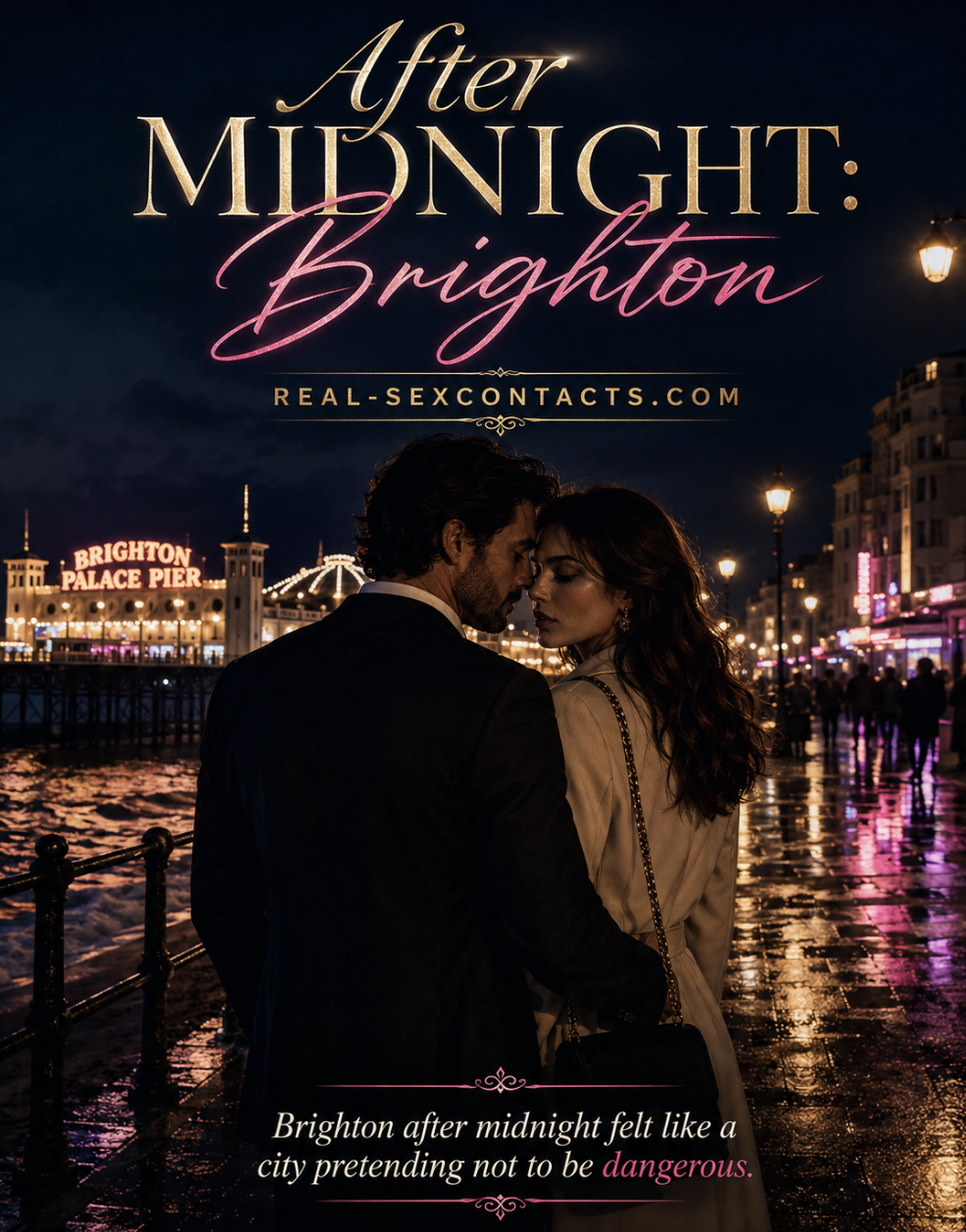
Brighton after midnight felt like a city pretending not to be dangerous.
That was part of its charm.
By day it belonged to colour, movement, sea air, windows full of light, people laughing too easily, and the bright performance of a place that knows it is being watched. But after midnight, Brighton changed. The city loosened its smile. The seafront darkened. The wind from the water turned colder, more intimate, and the lights along the promenade began to look less welcoming and more like clues left behind by a night unwilling to explain itself.
From the hotel window, the sea was almost invisible.
It began where the city ended and went on as blackness a dark, breathing distance beyond the glass. The wet pavement below held the streetlights in stretched golden lines. Cars moved slowly along the front, appearing and disappearing like thoughts too difficult to keep. Farther out, the pier stood against the dark with a strange, theatrical loneliness, beautiful and faintly untrustworthy, as if it belonged more to memory than to the present.
Brighton was romantic at that hour.
But not in any simple way.
It was romantic the way certain songs are romantic because they sound like they know something about heartbreak, temptation, and the mistake of staying longer than you meant to.
Inside, the room was warmer than the night outside.
A lamp burned low beside the bed.
A bottle of champagne rested in silver near the window.
Two glasses stood waiting.
Her heels had been left by the chair, one slightly turned away from the other, as though even objects in the room had begun to take on the mood of the evening.
She stood at the glass, one hand resting lightly against it, looking out over the wet shine of the seafront.
“Brighton looks different like this,” she said quietly.
He smiled from across the room. “Different how?”
She turned only enough for him to catch her reflection in the window.
“Like it’s finally telling the truth.”
That made him laugh softly.
That was what had unsettled him from the beginning — the way she took ordinary words and gave them a second life, darker and more interesting than the first.
He had found her on Brighton Sex Dating, long after an ordinary evening should have ended. It was late enough that messages usually became dull or careless. Hers did not belong to that hour. Her profile carried itself with a kind of composed mystery. No loud promises. No obvious attempt to impress. It had elegance instead — and something quieter beneath it that felt more dangerous because it refused to name itself.
She looked like the kind of woman who had seen too many bad messages and forgotten all of them.
So he made sure she would not forget his.
He wrote:
You look like the kind of woman who prefers intrigue to attention.
Her reply arrived eleven minutes later.
That depends whether the man writing it understands the difference.
That was all.
And somehow it was enough.
Enough to turn a late message into a drink.
Enough to turn a drink into a conversation that moved too easily to be accidental.
Enough to turn that conversation into this room, this hour, this city glowing wet and gold below them while the sea kept its own counsel in the dark.
She moved away from the window slowly, as if she understood exactly what slowness could do to a room.
“I liked your message,” she said.
He smiled. “Only liked?”
“It had restraint.”
“That sounds almost severe.”
“No,” she said softly. “It sounded rare.”
That answer landed with more force than it should have.
Because she meant it.
Because the room had already gone beyond playfulness into something richer.
Because Brighton, with all its dark glamour and sea-lit distance, made even compliments feel like confessions disguised in better clothes.
Outside, the city remained alive in fragments. A late cab passed. Somewhere, music drifted up faintly from below and vanished again in the wind. The promenade gleamed. The pier stretched into darkness. And all of it gave Brighton that unmistakable feeling of being both intimate and unknowable — a city built equally for pleasure and for leaving people wondering what, exactly, had happened to them there.
“You know what I like about Brighton?” she asked.
“The city or the hour?”
She smiled faintly.
“The fact that it always feels like something is about to happen.”
He looked past her toward the sea.
“Maybe something already has.”
That made her lower her eyes for a moment, not quite smiling, not quite hiding anything either.
Most first meetings rely too much on momentum. They rush. They ask for too much too early. But this had not done that. From the first message onward, it had unfolded with a kind of patient inevitability, as though the night already knew what shape it wanted and neither of them was foolish enough to interrupt it.
That was what made it seductive.
Not urgency.
Not bluntness.
Atmosphere.
Timing.
The knowledge that anticipation, if handled well, can be more intimate than touch.
He stepped closer.
“What made you reply?” he asked.
She did not answer immediately.
Instead she picked up one of the champagne glasses, turned it once between her fingers, then placed it back on the table untouched. Even that seemed meaningful. As though she preferred the tension exactly as it was and did not want to dilute it with anything simpler.
“You sounded observant,” she said at last.
“That’s a dangerous compliment.”
“Only if it’s true.”
He smiled. “And was it?”
Her gaze moved toward the window, toward the black seam where the sea began.
“You noticed the dark before the lights.”
That answer stayed with him.
Because it was too precise to be casual.
Because it meant she had been paying attention to him from the beginning.
Because there was something about Brighton after midnight — the wet glass, the distant sea, the false softness of the city lights — that made that kind of understanding feel less surprising than it should have.
He poured the champagne.
The sound of it entering the glasses seemed unnaturally bright in the hush.
He handed one to her.
Their fingers touched briefly. Accidentally, if one insisted on innocence.
“To Brighton,” he said.
She accepted the glass and looked toward the window again.
“To cities that hide themselves well.”
They drank.
The champagne was cold and bright and almost cruel in how quickly it was gone.
She set her glass down first.
Then she moved back toward the window, and after a moment he followed, stopping beside her. From there the city looked even stranger. The promenade below seemed too empty, the lights too polished, the sea too black to trust. The pier looked like a beautiful lie disappearing into darkness.
“It feels lonely,” he said quietly.
“Brighton?”
“The sea.”
She turned toward him then, and there was something softer in her face than there had been downstairs.
“Maybe that’s why people come here,” she said. “To feel less alone without having to say it.”
That line changed the room more completely than anything else had.
Because beneath the heat in the room — and there was heat, unmistakable in the unfinished pauses, the measured closeness, the way her eyes drifted once toward the bed and then away again — there was something else now. Something more dangerous because it was gentler.
Recognition.
The possibility that the night was no longer only about attraction.
The first quiet outline of tenderness.
The unsettling feeling that whatever had begun on Brighton Sex Dating had already become too intimate to dismiss as chemistry alone.
He looked at her reflection in the glass.
“And is that why you came?”
She smiled, though it came slowly, as though she had to decide how much truth the moment deserved.
“No,” she said. “I came because I was curious.”
A pause.
“But curiosity has a habit of becoming something more expensive.”
He laughed softly. “Expensive?”
She looked at him fully now.
“Yes.”
Another pause.
“Because once a night begins to matter, it costs more to leave it behind.”
Brighton suited that kind of truth.
It was a city made of surfaces that concealed depth — glitter over darkness, colour over ache, pleasure beside loneliness, the bright promise of amusement against the endless black of the water. Romance there was never innocent. It always came with a shadow. That was precisely why it worked.
He lifted one hand and brushed a loose strand of hair away from her shoulder, moving slowly enough to give her all the time in the world to step back.
She didn’t.
Instead, her hand came to rest lightly against his chest.
Barely any pressure.
Barely any movement.
But enough to alter the entire atmosphere again.
“That message,” she said, her voice lower now, “was better than most.”
“And this night?”
She looked once toward the bed, once toward the dark beyond the glass, then back at him.
“This night,” she said softly, “feels like the kind people later describe badly because they’re frightened of how much it changed.”
He smiled. “And did it?”
For a moment, the only sounds were the wind against the window and the low, distant murmur of Brighton continuing below them without care.
Then she said:
“Yes.”
A small pause.
“Because the best nights are never just seductive.”
Her fingers moved slightly against his shirt.
“They are the ones that make you feel seen before you’re ready for how much you like it.”
That line stayed there between them.
Bright as champagne.
Dark as the sea outside.
Too honest to reduce to flirtation, too intimate to call accidental.
The room held a particular kind of heat by then — not obvious, not hurried, but deep and elegantly wicked. It was there in the closeness, in the unresolved glances, in the exquisite restraint of two people who knew the atmosphere would only get better if neither of them rushed to spoil it. It was there in the bed catching the amber light, in the city shining below, in the way the night seemed to have folded itself around them and refused to let the outside world in.
But what made it unforgettable was not only desire.
It was the suggestion of love’s first shadow.
Not love itself.
Not yet.
Only the place where it might begin — hidden inside fascination, dressed as mystery, arriving quietly enough that by the time you recognise it, you are already too far inside the moment to escape without regret.
Outside, Brighton kept its secrets in the sea and the dark.
Inside, the room kept theirs.
One message.
One reply.
One city after midnight.
And one meeting that no longer felt accidental enough to call casual.
Sometimes people go looking for excitement.
Sometimes for mystery.
Sometimes for the right stranger at the right hour.
And sometimes, after midnight in Brighton, they find something stranger and more beautiful than all of those — a dark seafront, a room lit like a confession, and a connection that begins in intrigue and lingers like the memory of a wave breaking somewhere you can’t quite see.
