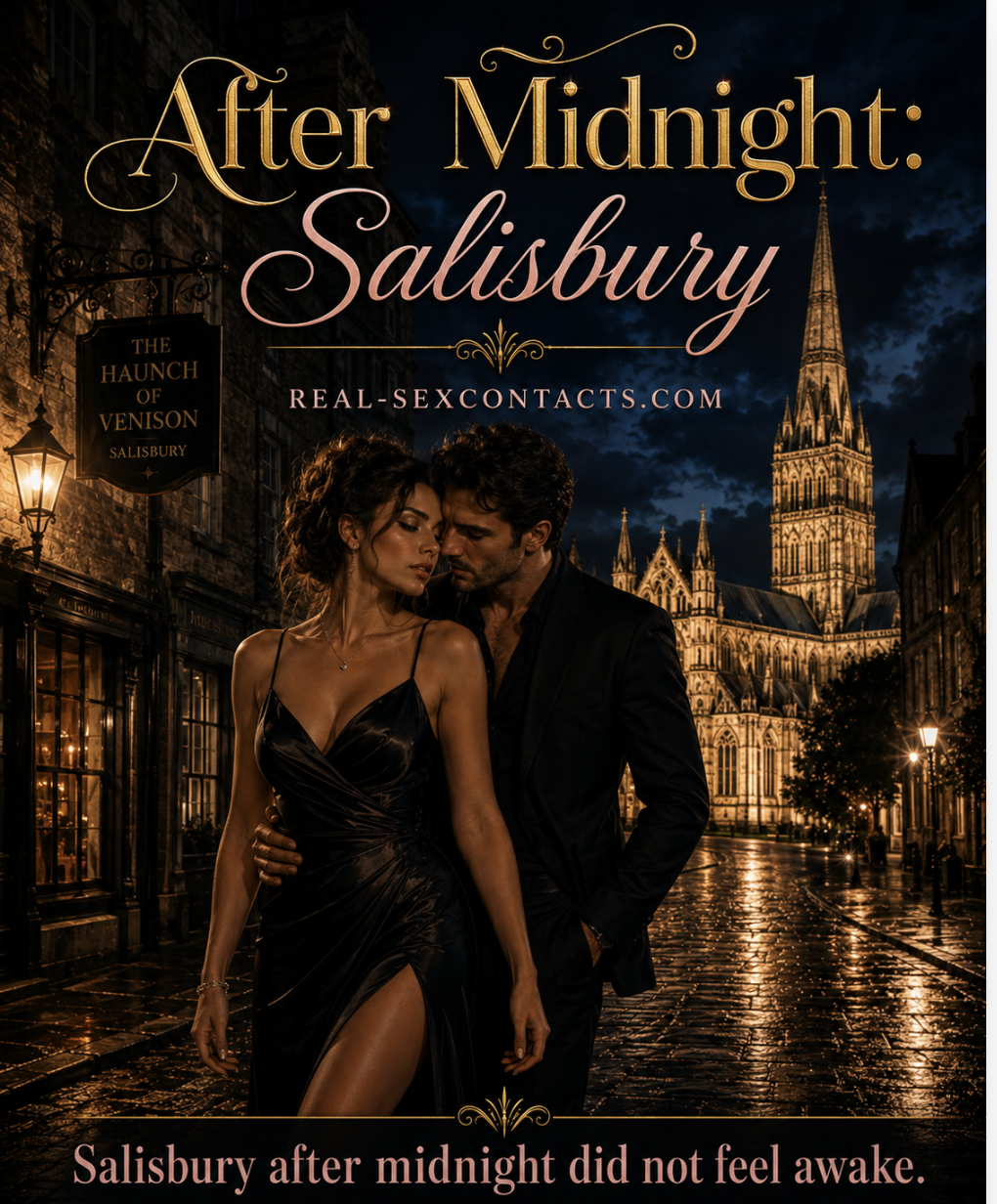
Salisbury after midnight did not feel awake.
It felt summoned.
Some cities remain themselves after dark, only quieter. Salisbury did not. It seemed to pass into another state entirely older, dimmer, more intimate with the things people usually keep hidden. The streets shone with rain. The stone held the cold. The cathedral, somewhere beyond the wet roofs and silent lanes, did not merely dominate the skyline; it altered the mood of everything beneath it. Its unseen presence made even private desires feel briefly sacred, or dangerous enough to resemble it.
From the hotel window, the city looked almost impossible to belong to the present.
The lamps cast long amber reflections along the empty street below. The rain had polished the pavements until they gleamed like black lacquer. A late taxi passed once and was gone, leaving the town to its silence, its stone, and the feeling that anything spoken there after midnight might be remembered longer than intended. Salisbury did not look romantic in the easy sense. It looked like a place where love, if it arrived, would come wearing mourning colours and no intention of leaving gently.
Inside, the room was warm enough to feel like betrayal.
A lamp burned low beside the bed.
A bottle of champagne stood waiting in silver near the window.
Two glasses rested untouched beside it.
Her heels stood near the chair, close together, elegant and faintly accusatory, as though they had already witnessed more than either of them meant to admit.
She was standing at the glass when he looked up.
One hand lightly resting against it.
Rain softening her reflection.
The city beyond her blurred into gold and darkness, so that she seemed less like a woman in a room and more like a memory that had chosen, for one hour only, to become visible.
“Salisbury feels haunted,” she said quietly.
He smiled from across the room. “Haunted?”
She turned slightly, enough for the light to touch her face.
“By restraint,” she said.
A pause.
“And all the things it fails to save.”
That made him laugh softly, though not because the line was amusing. Because it was too beautiful not to unsettle him.
That was what had drawn him in from the beginning — not simply that she was beautiful, but that she seemed to speak as if every sentence had already passed through silence and returned carrying only what mattered.
He had found her on Salisbury Sex Dating, late enough for ordinary messages to become impossible. Her profile had not tried to be seductive. It had done something more effective. It had withheld. There was elegance in it, but also distance. Not coldness — something more difficult than that. The sort of composure that made lazy attention feel not merely inadequate, but vulgar.
So he had not written anything vulgar.
He had taken his time.
He wrote:
You look like the kind of woman who would rather be haunted than admired.
Her reply came twelve minutes later.
That depends whether the man writing it understands what he’s asking for.
That was all.
And somehow, it had become this — Salisbury after midnight, rain on the window, old stone holding the dark below them, champagne waiting untouched, and a room already full of the kind of atmosphere that makes people speak more softly than they mean to.
She moved away from the window slowly, and the room seemed to shift around her.
“I liked your message,” she said.
He smiled. “Only liked?”
“It had seriousness.”
“That sounds severe.”
“No,” she said softly. “It sounded costly.”
That answer landed more deeply than flirtation should have.
Because she meant it.
Because Salisbury, with all its ancient quiet and ceremonial beauty, made even desire seem obliged to examine itself.
Because the room had already grown too intimate for wit alone to survive.
Outside, the city remained rain-dark and almost ecclesiastical in its composure — narrow streets, pale stone, deep shadow, the whole place held under the silent weight of history. It was the kind of city where romance did not arrive brightly. It arrived with sorrow already folded into it. Not sadness, exactly — the more dangerous thing. The feeling that beauty and loss had been neighbours there for centuries and had long ago stopped pretending not to recognise each other.
He stepped closer.
“What made you reply?” he asked.
She did not answer at once.
Instead, she lifted one of the champagne glasses, held it up as though considering the light through it, then placed it back on the table untouched. Even that felt intimate. As though she knew the room was already saying enough and refused to interrupt it with anything less subtle than thirst.
“You sounded patient,” she said at last.
“That’s not often taken as seduction.”
“It should be.”
He smiled faintly.
Her eyes remained on him, steady and unreadable.
“Most men think desire is urgency,” she said. “Your message sounded like you understood it can also be endurance.”
That changed the room.
Not suddenly.
Not theatrically.
But enough.
Enough for the silence to thicken.
Enough for the light to seem softer around her throat and shoulders.
Enough for the space between them to become something neither of them could still plausibly call accidental.
He poured the champagne.
The sound of it touching crystal was bright in the hush, almost indecent for a room this composed.
He handed one to her.
Their fingers brushed.
Accidental, perhaps, if one still believed innocence had not already left.
“To Salisbury,” he said.
She accepted the glass and looked once toward the rain-dark city.
“To things that should probably remain unsaid.”
They drank.
The champagne was cold, clean, fleeting.
She set her glass down first and drifted back toward the window. He followed after a moment, stopping close enough to see both her reflection and the old town beyond it. From there, Salisbury looked even more unreal — the wet street shining below, the darkness deepening between buildings, the old order of the city holding itself together as though the night had only sharpened its dignity.
“It feels like a city built for regret,” he said quietly.
She looked out at the rain.
“Not regret,” she said. “Consecration.”
He turned toward her. “That sounds worse.”
A faint smile.
“It usually is.”
That stayed between them.
So did the rain.
So did the old stone.
So did the unmistakable adult heat of a room in which two people had already stopped pretending this was simply an encounter.
There was seduction in the room, yes, but it did not feel modern. It did not feel casual. It was quieter than that and therefore more dangerous. It lived in the pauses. In the way her gaze drifted once toward the bed and then back to him without comment. In the way her shoulder nearly brushed his when she turned. In the way neither of them seemed willing to move too quickly, as if haste would insult not just the mood, but the city itself.
But what made the night haunting was not desire.
It was tenderness.
Not confessed.
Not named.
Only present — like the first line of a prayer neither of them believed in until suddenly they needed it.
That was what made the whole thing feel real.
Not merely the chemistry.
Not merely the elegance of a hotel room after midnight.
But the quiet suspicion that whatever had begun on Salisbury Sex Dating had already moved beyond attraction into something far more difficult to escape cleanly.
He looked at her reflection in the rain-dark glass.
“What are you really thinking?” he asked.
She was quiet long enough to make the answer matter.
“That Salisbury was supposed to feel distant,” she said.
A pause.
“I didn’t expect it to feel intimate.”
He looked again toward the wet street and the unseen mass of the cathedral beyond the roofs.
“And now?”
She turned toward him fully.
“Now I think some cities don’t seduce you.”
A small pause.
“They absolve you just long enough to do what you were already going to do.”
The room changed again after that.
Not dramatically.
Not visibly.
But enough.
Enough for the city beyond the window to feel farther away.
Enough for the warmth between them to become the only honest thing in the room.
Enough for him to notice her perfume as though it had only just entered the air.
He lifted one hand and brushed a loose strand of hair from her shoulder, moving slowly enough to let the gesture remain a question.
She didn’t step back.
Instead, her hand came to rest lightly against his chest.
Barely any pressure.
Barely any movement.
But enough to alter the meaning of everything.
“That message,” she said, voice lower now, “was better than most.”
“And this night?”
She looked once toward the bed, once toward the rain-bright city, then back at him.
“This night,” she said softly, “feels like the kind people later call reckless when what they really mean is irreversible.”
He smiled. “And was it?”
For a moment, the only answer was the rain at the window and the deep old hush of Salisbury holding itself around them.
Then she said:
“No.”
A small pause.
“It feels like the kind of night that starts as seduction and becomes dangerous the moment it begins to feel like fate.”
That found exactly where it meant to land.
Because beneath the dark beauty of the room, beneath the champagne and the old-city silence and the unmistakable heat of two people standing too close to keep pretending coincidence explains anything, there was recognition.
Not love, not yet.
But something close enough to cast its shadow.
The sense that this was no longer merely a beautiful mistake waiting to happen.
That the danger was no longer the attraction.
It was how quickly attraction had begun to feel intimate, specific, and impossible to leave in the room when morning came.
Outside, Salisbury kept its secrets in rain and stone.
Inside, the room kept theirs.
One message.
One reply.
One city after midnight.
And one meeting that had already become too personal to call accidental.
Sometimes people go looking for excitement.
Sometimes for temptation.
Sometimes for a stranger who knows how to say one unforgettable thing at exactly the right hour.
And sometimes, after midnight in Salisbury, they find something far more haunting — a city built of silence and devotion, a room lit like a confession, and a connection that begins in mystery and lingers like the memory of a kiss no one has yet dared to steal.
