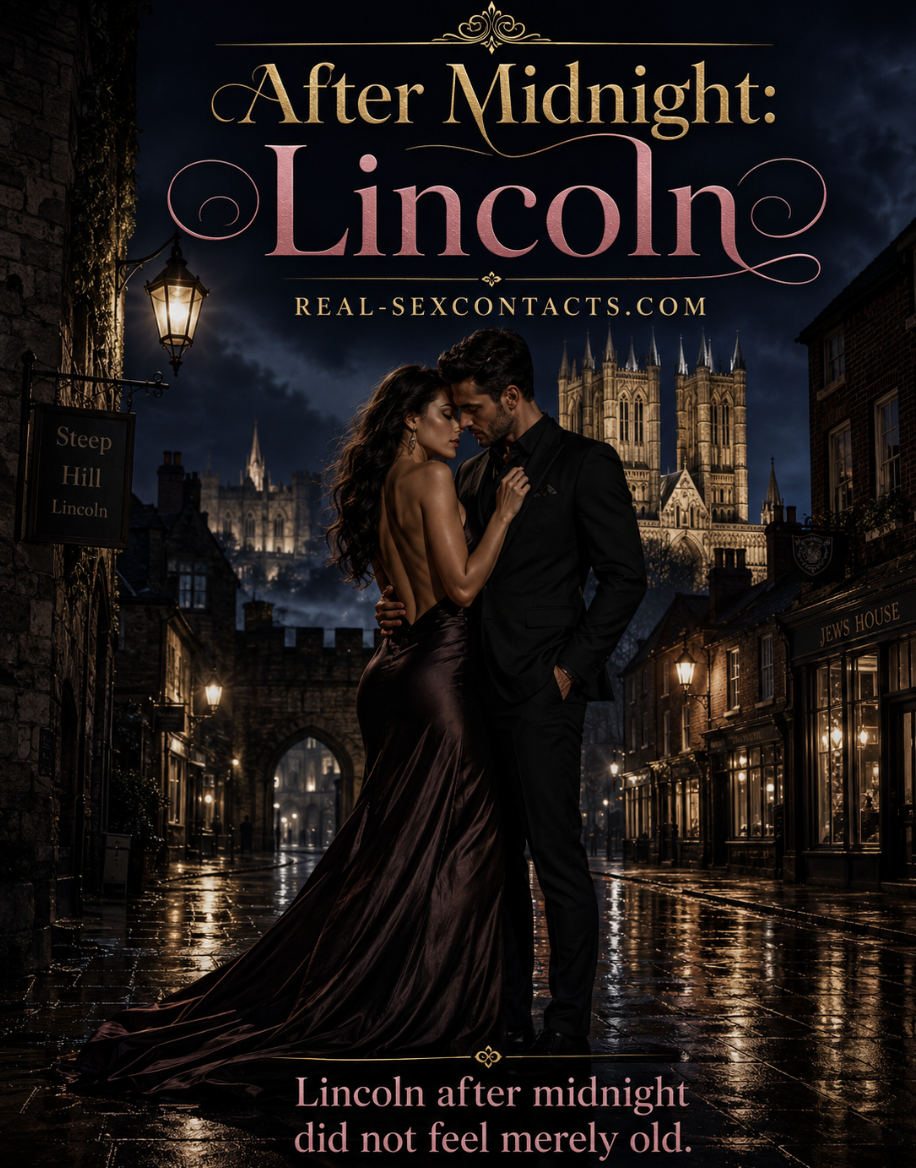
Lincoln after midnight did not feel merely old.
It felt consecrated to secrets.
Some cities become softer in darkness. Lincoln became sharper. The steep streets, the worn stone, the cathedral rising above the city like an act of judgement — all of it seemed to grow more deliberate at night. Rain made the pavements shine black beneath the lamps. Archways deepened into shadow. The old quarter seemed to pull away from the modern world and return to something older, more ceremonial, more dangerous. Lincoln did not invite innocence after midnight. It observed its absence.
From the hotel window, the city looked like a page torn from a gothic novel and left out in the rain.
The roofs were slick with darkness.
The narrow street below glimmered under amber light.
Somewhere beyond, higher and more ancient, the silhouette of the cathedral and castle held the skyline with a kind of patient authority. They did not merely overlook the city. They presided over it. And beneath them, the town seemed full of hidden vows, private trespasses, and beautifully kept sins.
Inside, the room was warm in a way that felt almost indecent.
A lamp cast low gold over white sheets.
A bottle of champagne waited in silver near the window.
Two glasses stood untouched beside it.
Her heels rested by the chair — elegant, still, accusatory — like relics from a scene that had not yet happened and had somehow already left evidence behind.
She stood at the glass when he looked up.
One hand rested lightly against it.
Rain blurred her reflection.
The city behind her was all stone and shadow, and for a moment she seemed less like a woman in a hotel room than an apparition summoned by solitude, dressed with exquisite care and no intention of being dismissed.
“Lincoln feels stricter at night,” she said quietly.
He smiled from across the room. “Stricter?”
She turned slightly, enough for the light to catch the pale line of her throat, the curve of her mouth, the unreadable composure in her expression.
“As if it approves of desire,” she said softly, “but only if it’s disciplined.”
That made him laugh under his breath.
That was what had drawn him to her from the very beginning — not just her beauty, though that was obvious, but the way she spoke as though every sentence had already been refined, stripped, and sharpened until only the most dangerous meaning remained.
He had found her on Lincoln Sex Dating late enough for ordinary flirtation to become unbearable. Her profile did not try to seduce. It did something much more effective. It suggested control. There was elegance in it, but also tension. The kind of self-possession that made lazy messages feel not only inadequate, but clumsy.
So he had not sent a clumsy one.
He had taken his time.
He wrote:
You look like the kind of woman who prefers control to chaos, and tension to noise.
Her reply came ten minutes later.
That depends whether the man writing it understands the difference between control and performance.
That was all.
And somehow it had led them here — Lincoln after midnight, rain at the window, old stone holding the dark beyond the glass, champagne waiting untouched, and a room already heavy with the kind of atmosphere that makes silence feel like part of the seduction.
She moved away from the window slowly, and the room seemed to tighten around her.
“I liked your message,” she said.
He smiled. “Only liked?”
“It had restraint.”
“That sounds almost punishing.”
“No,” she said softly. “It sounded expensive.”
That landed more deeply than wit usually could.
Because she meant it.
Because Lincoln, with all its old severity and gothic composure, made seduction feel less like play and more like ritual.
Because the room had already become too charged to tolerate anything careless.
Outside, the city remained dark and ceremonial — steep streets, old walls, rain-bright stone, silence collecting in the hollows of history. It was the sort of place where romance arrived wearing black and spoke quietly enough to be mistaken for temptation. And temptation there did not feel wild. It felt arranged. Measured. Chosen.
He stepped closer.
“What made you reply?” he asked.
She did not answer immediately.
Instead, she lifted one of the champagne glasses, turned it lightly by the stem, then set it down again untouched. Even that seemed intimate — the refusal to break the mood before it had fully ripened.
“You sounded observant,” she said at last.
“That’s a dangerous compliment.”
“Only if it’s true.”
He glanced toward the rain-dark window. “And was it?”
Her gaze followed his.
“You noticed the mood before the view.”
A pause.
“Most men rush to describe the obvious.”
He smiled faintly. “And I didn’t?”
“No.” Her eyes returned to him. “You sounded like someone who understands anticipation can be more intimate than touch.”
That changed the room.
Not suddenly.
Not dramatically.
But enough.
Enough for the silence to thicken.
Enough for the lamplight to seem softer at the edges.
Enough for the distance between them to stop feeling incidental and start feeling intentional.
He poured the champagne.
The sound of it entering the glasses was bright in the hush, almost indecently alive.
He handed one to her.
Their fingers brushed.
Accidental, perhaps, if either of them still believed innocence belonged anywhere in the room.
“To Lincoln,” he said.
She accepted the glass and glanced once back toward the dark city beyond the glass.
“To restraint,” she said.
A beat.
“And the interesting things it fails to prevent.”
They drank.
The champagne was cold, elegant, and gone too quickly.
She set her glass down first and moved back toward the window. He followed after a moment, stopping close enough to see both her reflection and the city beyond it. From there, Lincoln looked even more unreal — steep, shadowed, severe. The cathedral’s dark presence seemed to press against the night itself. The old streets below gleamed as though polished for confession.
“It feels like a city built for obedience,” he said quietly.
She looked out at the rain.
“No,” she replied. “For surrender.”
Then, after a pause:
“But only to the right things.”
That line stayed there between them.
So did the rain.
So did the old stone.
So did the unmistakable heat of a room in which two people had already stopped pretending this was simply attraction.
There was seduction in the room, yes, but darker now. More deliberate. It was not the careless kind. It lived in control. In the way her voice lowered instead of breaking. In the way her gaze lingered just long enough to become instruction. In the way she glanced once toward the bed and then back to him as if she expected him to understand suggestion without reducing it by naming it too quickly.
And beneath it, something else.
Something more dangerous.
Trust.
Not granted.
Not spoken.
Only beginning to gather — that rare and volatile feeling that makes tension sharper, because it is no longer only about desire. It is also about permission. About being read correctly. About knowing when to lead, when to wait, when to let silence tighten until it becomes unbearable in the most exquisite way.
That was what made the atmosphere so charged.
Not just chemistry.
Not just the dark glamour of a hotel room after midnight.
But the quiet sense that whatever had begun on Lincoln Sex Dating had already moved beyond flirtation and into something more precise, more adult, more difficult to dismiss in the morning.
He looked at her reflection in the rain-dark glass.
“What are you really thinking?” he asked.
She was silent long enough to make the answer worth hearing.
“That Lincoln was supposed to feel austere,” she said.
A pause.
“I didn’t expect it to feel intimate.”
He looked out again toward the cathedral-dark skyline.
“And now?”
She turned toward him fully.
“Now I think some places make people more honest.”
A small pause.
“Especially about what they want.”
The room changed again after that.
Not theatrically.
Not all at once.
But enough.
Enough for the city beyond the window to recede.
Enough for the warmth between them to become the truest thing in the room.
Enough for him to notice the faint scent of her perfume as though it had only now reached him.
He lifted one hand and brushed a loose strand of hair from her shoulder, moving slowly enough to let the gesture remain a question.
She didn’t move away.
Instead, she held his gaze with that same composed intensity that had unsettled him from the first reply.
“That message,” she said, voice lower now, “was very seductive.”
“And this night?”
She looked once toward the bed, once toward the rain-bright city, then back at him.
“This night,” she said softly, “feels like the kind people later call dangerous when what they really mean is revealing.”
He smiled. “And was it?”
For a moment, the only answer was the rain at the window and the deep gothic hush of Lincoln holding itself around them.
Then she said:
“No.”
A small pause.
“It feels like the kind of night that starts as seduction…”
Her fingers came lightly to rest against the front of his shirt.
“…and becomes something else the moment desire stops being only physical and starts becoming about trust.”
That found exactly where it meant to land.
Because beneath the dark beauty of the room, beneath the champagne and the old-city silence and the unmistakable adult charge of control, tension, and chosen closeness, there was recognition.
Not love, not yet.
But something close enough to cast a long shadow.
The sense that this was no longer merely a beautiful encounter.
That the danger was no longer the attraction.
It was how quickly attraction had become specific, intimate, and impossible to reduce to appetite alone.
Outside, Lincoln kept its secrets in rain and stone.
Inside, the room kept theirs.
One message.
One reply.
One city after midnight.
And one meeting that had already become too personal to call casual.
Sometimes people go looking for excitement.
Sometimes for temptation.
Sometimes for a stranger who knows how to write one perfect line at the right hour.
And sometimes, after midnight in Lincoln, they find something far more gothic and far more seductive — a city built of shadow and ritual, a room lit like a private vow, and a connection that begins in tension, deepens through control, and lingers like the memory of surrender offered only where trust has already begun.
