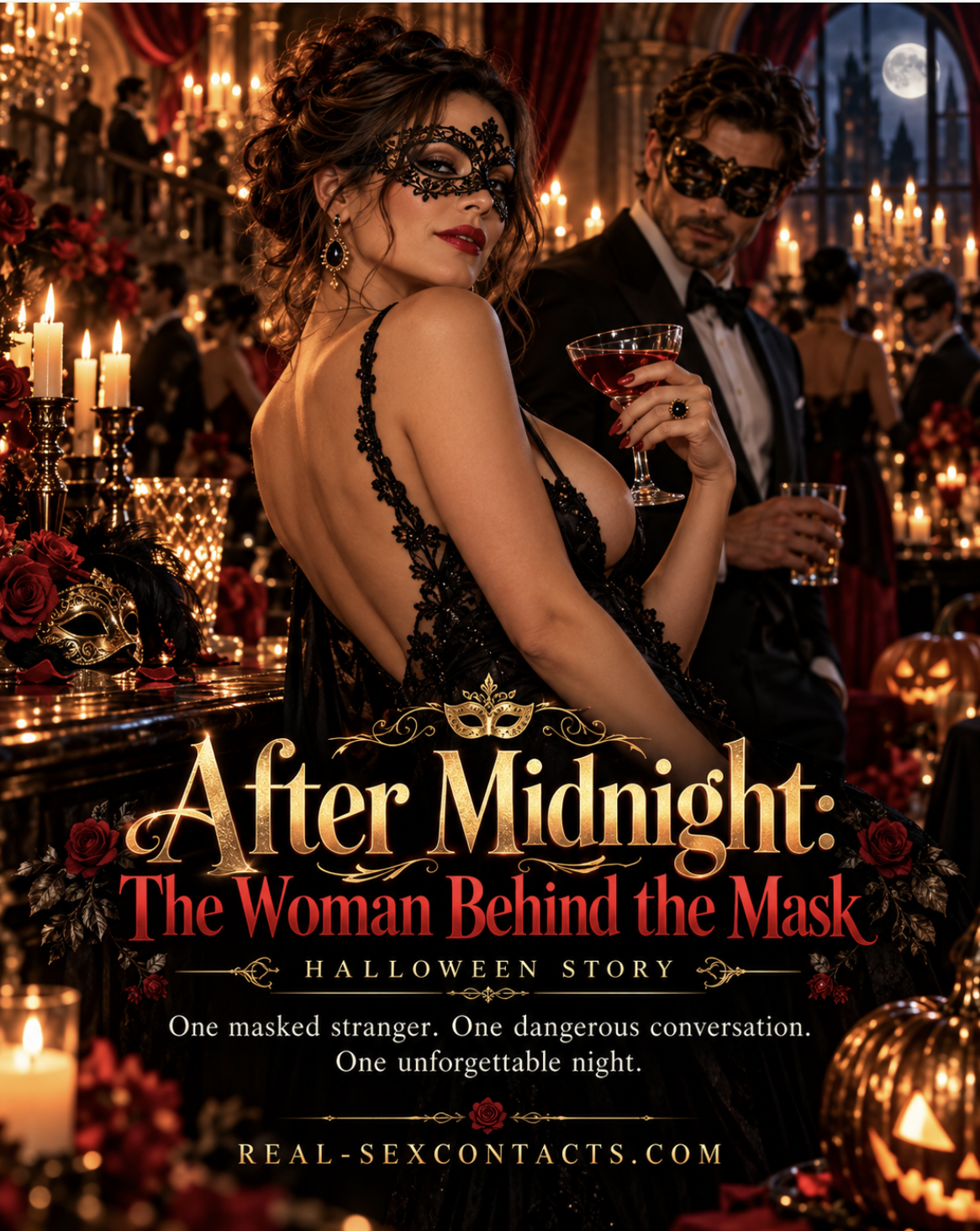
By the time he arrived, the party had already become the kind of night people would lie about later.
Not because anything scandalous had happened yet.
Because the house itself made honesty feel unlikely.
It stood at the end of a narrow street in Kensington, half-hidden behind iron gates and dark trees stripped bare by October wind. Inside, candles burned in long corridors. Black roses curled from silver vases. A string quartet played somewhere above the low pulse of modern music drifting up from below. Every room seemed lit for secrets rather than conversation.
It was a masquerade.
Naturally.
Halloween in London encouraged that sort of theatricality.
Masks were not required, but many had worn them anyway. Velvet. Lace. Gold leaf. Black feathers. Men in dark suits and women in dresses cut to suggest drama rather than innocence. Champagne moved through the rooms on silver trays. Laughter arrived in fragments and disappeared just as quickly.
He had almost not come.
A friend had insisted.
“You need one good October night,” his friend had said. “Something a little less respectable than your usual Friday.”
He had expected pretension.
He had not expected her.
He saw her across the drawing room.
Black mask.
Black gloves.
Black heels.
And a dress the colour of old red wine.
It was not bright enough to be scarlet and not dark enough to vanish into shadow. The fabric caught candlelight whenever she moved, changing from crimson to burgundy to something almost black at the edges. The neckline was low, elegant, impossible not to notice. Her mouth was painted a deeper red than the dress. Her dark hair had been pinned up, though several strands had escaped deliberately and softened the severity of the mask.
She was standing alone near the window, one hand around the stem of a champagne glass, watching the room as though none of it belonged to her and all of it did.
He looked too long.
She noticed.
Then, without smiling, she lifted her glass slightly in his direction.
An invitation.
Or a warning.
He crossed the room.
“Do I know you?” he asked.
Her eyes moved over him behind the mask.
“No.”
“Then why do I feel as though I should?”
“Because,” she said, “you’ve been staring at me for nearly a minute.”
Her voice was low and calm and faintly amused.
“I was trying to work out whether you wanted me to come over.”
“And?”
“I’m still not sure.”
That made her smile.
Only slightly.
“That’s because you came over too quickly.”
He laughed.
“You prefer patience?”
“I prefer confidence without desperation.”
There it was.
That tone.
Not flirtation exactly.
Something cooler.
More dangerous.
He looked at the mask.
Black silk, shaped to sharpen the line of her cheekbones.
“And do you talk to everyone like this?”
“No.”
“Just strangers at midnight?”
“It isn’t midnight yet.”
He checked his watch.
11:54.
“Then I’m early.”
“For what?”
She took a sip of champagne.
“The mistake.”
He should have asked what she meant.
Instead, he found himself smiling.
“Do you always announce there will be a mistake before it happens?”
“Only when I’m trying to give somebody a chance to avoid it.”
He leaned one shoulder lightly against the wall beside her.
“And if I don’t want to avoid it?”
Her eyes held his for a moment longer than was necessary.
“Then we may get on.”
The Mask
He learned almost nothing about her in the next twenty minutes.
Not her surname.
Not her job.
Not whether she lived in London or merely visited it.
Every direct question was answered sideways.
“Are you from here?”
“Sometimes.”
“What does that mean?”
“It means I know my way home.”
“Are you here with someone?”
“Yes.”
He looked around.
“Where are they?”
She met his eyes.
“Talking to you.”
That made him laugh again.
She liked making him laugh. He could tell because the corner of her mouth kept lifting when he did.
Around them, the party deepened. More candles were lit. Music shifted. Shadows became part of the décor. Upstairs, a door opened onto a balcony where smoke and cold air drifted through the hall. The windows reflected masked faces back into the room until everyone looked doubled.
He began to understand the appeal of the mask.
It turned a woman into an idea.
Not less attractive.
More.
He could see her mouth, the line of her throat, the pale shape of one shoulder above the dress. He could see her eyes, dark and direct beneath black silk. But not enough to feel he had fully reached her. The concealment sharpened attention instead of reducing it.
“You like it,” she said.
“The mask?”
“Yes.”
“I do.”
“Why?”
“Because it’s cruel.”
For the first time, she seemed genuinely interested.
“Cruel?”
“It lets me see just enough.”
Her fingertips rested on the base of the champagne glass.
“And what is it you think you want to see?”
He looked at her mouth.
Then back at her eyes.
She noticed.
“Ah,” she said softly. “That.”
After Midnight
At twelve o’clock, the lights in the drawing room dimmed.
Not fully.
Just enough to make the room glow darker.
From somewhere above the staircase came the low tolling of a clock striking midnight. A cheer rose from another room. Someone laughed too loudly. The quartet stopped. Music with more rhythm took over from downstairs.
She turned toward the door.
“Come with me.”
He followed without asking where.
They moved through the corridor and out into the garden.
It was colder outside than he expected.
The house backed onto a walled courtyard lit by lanterns and scattered candles protected inside glass cylinders. Black leaves skittered over the stone. The city felt impossibly far away for central London.
Only two other people were outside, both at the opposite end of the terrace, smoking and talking quietly.
She walked to the far side of the garden where a stone bench sat beneath a dead climbing rose.
The mask made her seem less like a party guest than a character from a dream he might regret in the morning.
“Why did you bring me out here?” he asked.
She turned to face him.
“Because you were beginning to ask sensible questions.”
“And that bored you?”
“Yes.”
The honesty of it made his pulse shift.
He stepped closer.
“Then give me a better one.”
For a moment she said nothing.
Wind moved a strand of dark hair across her cheek.
Finally:
“What would you do if you never found out my name?”
He looked at her.
“Tonight?”
“Yes.”
“Or ever?”
Her eyes stayed on his.
“Ever.”
He thought for a second.
Then answered carefully.
“I’d still remember your mouth.”
The silence between them changed immediately.
No laughter this time.
No teasing.
Only the sound of leaves moving across stone and faint music from the house behind them.
“You are better after midnight,” she said.
“So are you.”
She set down her empty glass on the edge of the bench.
Then reached up and removed one glove.
Slowly.
Finger by finger.
The gesture was almost nothing.
It felt intimate enough to alter the air.
He watched her bare hand emerge into the lantern light.
She touched the lapel of his jacket lightly.
“Perhaps,” she said, “that was the mistake.”
“What was?”
“Letting you follow me.”
Her fingers moved once over the fabric.
“Do you want me to go back inside?”
“No.”
The answer came quickly.
Quietly.
But without hesitation.
She smiled.
“Good.”
The Woman Behind the Mask
He touched her wrist first.
Then her hand.
Not taking it. Just feeling the warmth of her skin against the cold night.
She did not move away.
Instead, she stepped closer, until the deep red of the dress was the only colour he could really see in the dark garden.
“Tell me something true,” she said.
“I want to kiss you.”
“Too easy.”
“You said true, not original.”
Her bare hand moved to the back of his neck.
The black mask had made her seem untouchable in the drawing room.
Now it made the distance between concealment and closeness almost unbearable.
“What if I tell you no?” she whispered.
“Will you mean it?”
Her eyes changed.
There it was again, that flash of approval when he answered correctly.
“No,” she said.
“Then I won’t believe you.”
This time she laughed very softly.
Then she pulled him toward her and kissed him before he could decide whether the night was still happening to him or because of him.
The kiss was warm and deliberate and only slightly cruel, exactly like the rest of her.
One gloved hand against his chest.
One bare hand at his neck.
Her lipstick had a faint taste of red wine.
When she broke away, they stayed close enough that he could feel her breath.
He looked at the mask.
“Can I see your face?”
“No.”
“Why not?”
“Because this is better.”
“Better for who?”
“For the story.”
He smiled.
“You think like that?”
“At midnight on Halloween?” she said. “Always.”
They kissed again, slower this time, deeper, the cold air making the warmth between them feel sharper.
When they finally separated, she stepped back first.
Not far.
Enough.
Then she picked up the black glove and slipped it on again.
The return of it felt almost indecent.
“Now what?” he asked.
“Now,” she said, lifting her glass again, “you go back inside.”
“That’s disappointing.”
“You’ll survive.”
“And you?”
She tilted her head.
“I was enjoying the mystery.”
“So was I.”
She began walking toward the house.
Halfway to the door, she turned.
“For what it’s worth,” she said, “I did want you to come over.”
Then she disappeared into candlelight, music and masks.
He never learned her name.
Only that every year, when London turns cold and Halloween parties begin again, he still thinks about the woman behind the mask.
And still wonders whether not knowing was the entire point. To meet her tonight join REAL SEX CONTACTS
